

A car battery that dies after sitting usually loses charge because of a parasitic electrical draw, an aging or damaged battery, extreme temperature, or an undercharging problem. Even when the ignition is off, many modern vehicles continue using electricity for computers, alarms, keyless-entry systems, telematics, and memory functions.
For drivers in the United States, the problem may become more noticeable after a car sits overnight, during a vacation, or through a hot summer or freezing winter. The fastest way to identify the cause is to determine whether the battery is failing to hold a charge, the vehicle is drawing too much power while parked, or the alternator is not fully recharging the battery while driving.
What Happens When a Car Sits
A parked vehicle is not electrically inactive. Modern cars typically enter a low-power “sleep” state after the doors are closed and control modules shut down, but some systems must remain ready to operate.
Normal parked power use may include:
- The vehicle security system
- Remote keyless entry
- Body and engine computers
- Radio and clock memory
- Telematics or connected-car services
- Alarm and immobilizer systems
- Interior monitoring sensors
- Power liftgate or door-control modules
- Battery monitoring equipment
This small, continuous demand is called parasitic draw or key-off current. A healthy, fully charged battery can normally support a properly functioning vehicle for days or weeks, depending on the vehicle, battery condition, temperature, and the amount of standby current.
The problem begins when the vehicle fails to enter sleep mode, a component remains active, or the battery has lost enough capacity that even a normal draw depletes it.
A lead-acid automotive battery also loses charge naturally while sitting. This self-discharge is usually slow, but it becomes more significant when the battery is old, partially discharged, contaminated, damaged, or exposed to high temperatures.
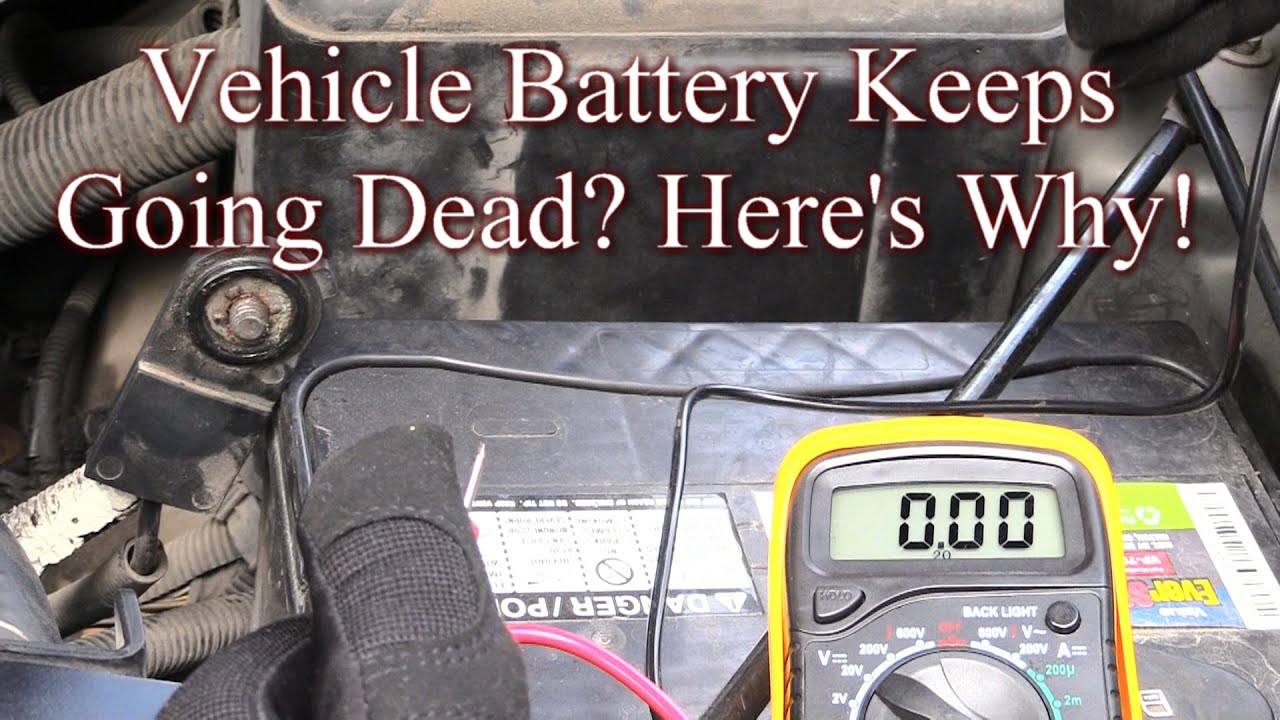
Source: Bing
The Most Common Reasons a Car Battery Dies After Sitting
The same symptom—no-start after the car sits—can result from several different faults. These are the most common causes, roughly ordered by how often they matter in real-world troubleshooting.
1. The battery is old or failing
A battery may show a normal voltage immediately after charging but still fail when the starter demands substantial current. Internal plate deterioration, sulfation, corrosion, and loss of active material reduce the battery’s usable capacity.
Many automotive batteries last approximately three to five years, although service life varies. Heat, frequent short trips, vibration, poor charging, and repeated deep discharges can shorten that range. Batteries in hot regions of the United States may age faster because sustained heat accelerates internal chemical degradation.
Common signs of a weak battery include:
- The engine cranks slowly
- The headlights dim during starting
- The battery repeatedly needs a jump-start
- The battery case is swollen, cracked, or leaking
- The vehicle starts after driving but fails after sitting
- A battery tester reports low cold-cranking performance
- The battery is several years old
A battery that has been fully discharged several times may be damaged even if it was recently installed.
2. A parasitic electrical drain is too high
A parasitic drain occurs when an electrical device consumes more power than the vehicle manufacturer intended while the car is parked.
Potential sources include:
- A glove-box, trunk, or vanity light that stays on
- An aftermarket alarm or remote starter
- A dash camera wired for parking-mode recording
- A plugged-in phone charger or accessory
- A failing alternator diode
- A radio or infotainment unit that never powers down
- A door, hood, or liftgate switch that falsely reports an open panel
- A body control module that remains awake
- A key fob stored too close to the vehicle
- A telematics or tracking device
- A malfunctioning power seat, window, or door module
Modern vehicles may need several minutes—or longer in some models—to shut down fully after the vehicle is locked. Measuring current immediately after switching off the ignition can produce a misleading result because the vehicle may still be completing its normal shutdown process.
3. The alternator is not fully charging the battery
The alternator replenishes battery energy while the engine runs. A failing alternator, worn belt, faulty voltage regulator, corroded cable, or poor ground connection can leave the battery undercharged.
A car may continue to start for a while with a weak charging system, especially if it is driven frequently. Eventually, however, the battery may not have enough reserve to start the engine after sitting.
Possible charging-system symptoms include:
- A battery or charging warning light
- Headlights that brighten or dim with engine speed
- Flickering dashboard lights
- Electrical accessories that operate inconsistently
- A whining or grinding alternator noise
- Repeated battery failure despite replacement
- A dead battery after several short drives
A new battery will not solve the underlying problem if the alternator or charging circuit is defective.
4. The vehicle is used mainly for short trips
Starting the engine uses a large amount of energy. A short drive may not provide enough time for the alternator to replace that energy, particularly when the vehicle is also powering a heater, defroster, heated seats, headlights, audio system, or other accessories.
Repeated short trips can gradually reduce the battery’s state of charge. The battery may then fail after sitting overnight even though no abnormal drain exists.
This pattern is common when a vehicle is used primarily for:
- Brief school or work commutes
- Multiple short errands
- Long periods of idling
- Seasonal or occasional driving
- Stop-and-go traffic with heavy accessory use
Idling is not always an effective substitute for driving. Alternator output varies by vehicle and engine speed, and extended idling may not restore a deeply discharged battery.
5. Extreme heat or cold reduces available battery performance
Temperature affects both battery capacity and vehicle starting demand.
Cold weather slows the battery’s chemical reactions and increases the engine’s resistance to cranking. A battery that starts a vehicle reliably in moderate weather may fail during a freezing winter night. Cold-cranking ratings are designed to describe a battery’s starting capability under specified test conditions, not to guarantee performance in every vehicle or climate.
High heat can accelerate battery aging. It may not cause an immediate no-start, but it can reduce the battery’s long-term capacity and make failure more likely months later.
Weather-related risk is higher when the battery is already partially charged, old, or damaged.
6. Corroded or loose battery connections limit current
A battery can be fully charged yet unable to deliver enough current through corroded terminals, loose clamps, damaged cables, or a poor engine ground.
Inspect for:
- White, blue, or green corrosion around the terminals
- Loose terminal clamps
- Frayed or swollen battery cables
- A damaged ground strap
- Corrosion where the negative cable connects to the body or engine
- Heat damage near the positive terminal or fuse box
Do not assume the battery itself is defective until the connections have been inspected and tested.
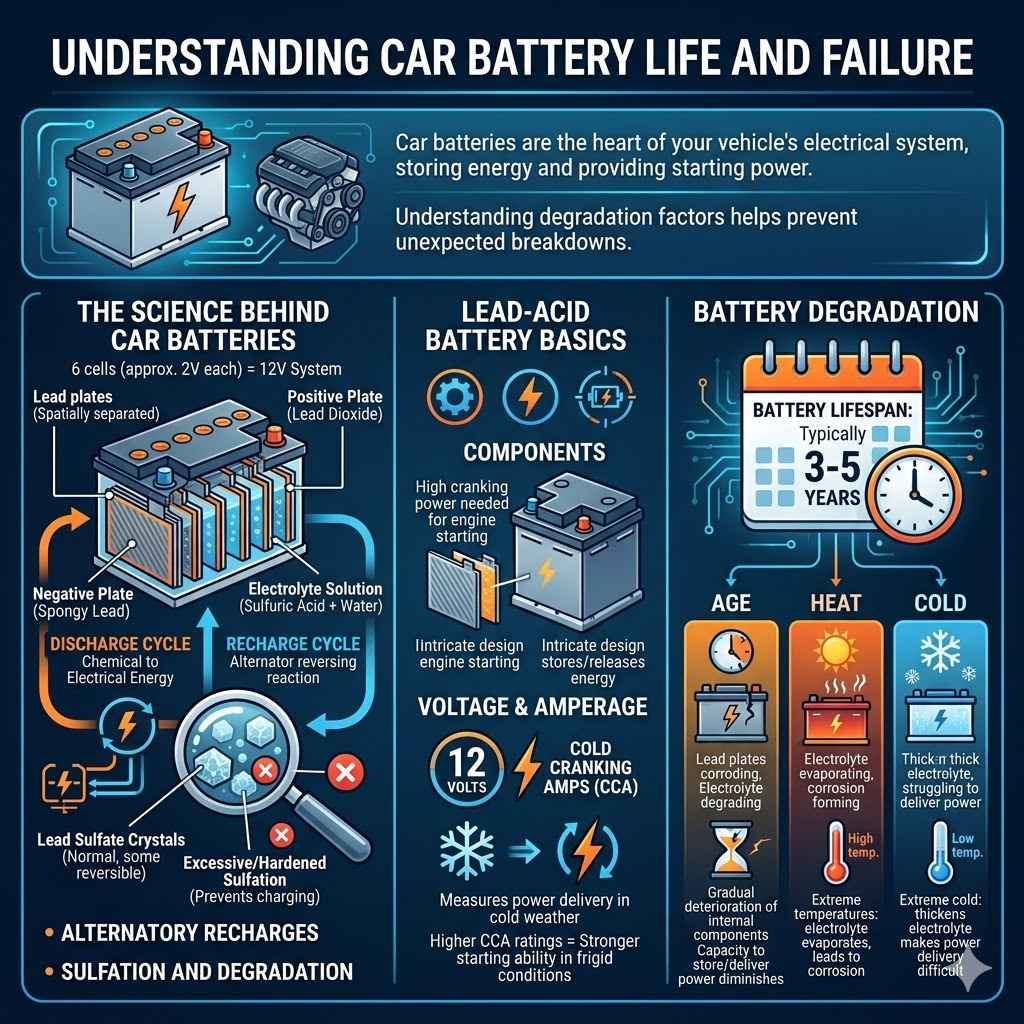
Source: Bing
How to Tell Whether the Battery, Alternator, or Parasitic Draw Is at Fault
The most useful diagnostic sequence is to start with simple observations and then measure the system under the correct conditions.
Step 1: Record what happens when you try to start
The starting symptom provides an initial clue:
| Symptom | More likely causes |
|---|---|
| Rapid clicking and dim lights | Low battery charge or poor battery connection |
| One heavy click with no crank | Starter, cable, connection, or low battery |
| Slow cranking | Weak battery, poor connection, or starting-system problem |
| Normal cranking but engine does not start | Fuel, ignition, security, or engine-management problem rather than the battery |
| Battery is dead after several days but starts after a jump | Weak battery, parasitic draw, or undercharging |
| Battery warning light while driving | Charging-system fault |
| Vehicle loses power immediately after a jump | Severe charging or connection problem |
These clues are not conclusive. A proper test is needed before replacing parts.
Step 2: Inspect the battery and connections
Turn the vehicle off and inspect the battery before attempting electrical tests.
Do not use or charge a battery that is:
- Cracked
- Leaking
- Severely swollen
- Frozen
- Hot or emitting an unusual odor
Wear eye protection when working near a battery. Keep sparks, cigarettes, and open flames away from the battery because charging can produce flammable gas.
If the terminals are dirty or corroded, clean them using appropriate battery-terminal tools and follow the vehicle and battery manufacturer’s instructions. Make sure the clamps are tight after cleaning.
Step 3: Measure resting voltage correctly
A digital multimeter can provide a useful initial check. For a conventional 12-volt lead-acid battery, approximate open-circuit readings are often interpreted as follows:
| Resting voltage | Approximate state of charge |
|---|---|
| 12.6–12.8 volts | Fully charged |
| About 12.4 volts | Approximately 75% |
| About 12.2 volts | Approximately 50% |
| About 12.0 volts | Very low |
| Below 12.0 volts | Severely discharged or potentially damaged |
These values are estimates, not a definitive battery-health test. Temperature, surface charge, battery design, and recent charging affect the reading. Let the vehicle sit with the electrical system off for several hours, preferably overnight, before measuring.
A battery may read near 12.6 volts and still fail a load or conductance test. Conversely, a low reading may simply mean the battery needs proper charging before its condition can be judged.
Step 4: Check charging voltage
With the engine running, measure voltage at the battery terminals only if the vehicle manufacturer’s procedure permits it and you know how to use a multimeter safely.
Many conventional charging systems produce a voltage higher than the battery’s resting voltage, often roughly in the 13.5- to 14.8-volt range. However, modern vehicles may use computer-controlled or variable-voltage charging. Some systems intentionally reduce charging voltage under certain conditions, so a single measurement cannot establish that the alternator is defective.
A professional charging-system test can evaluate:
- Alternator output
- Charging voltage under load
- Voltage drop across positive and ground cables
- Voltage-regulator operation
- Alternator diode ripple
- Battery state of health
Step 5: Test for parasitic draw only after the vehicle sleeps
A parasitic-draw test requires care because disconnecting the battery or opening doors can wake control modules and change the result.
A general procedure is:
- Fully charge the battery.
- Turn off the vehicle and remove the key or switch off the push-button ignition.
- Close and latch doors, hood switches, and the trunk as needed.
- Lock the vehicle if the manufacturer’s procedure calls for it.
- Wait long enough for the modules to enter sleep mode.
- Measure current with a suitable meter or use a professional battery analyzer.
- If the draw is excessive, remove fuses one at a time to identify the affected circuit.
- Inspect the components on that circuit and retest after repairs.
The expected current varies by vehicle. A small, stable draw after the vehicle is fully asleep may be normal, while a substantially higher draw or a vehicle that repeatedly wakes up indicates a problem.
Do not place a multimeter in current mode directly across the battery terminals. That can short the battery through the meter and damage the meter, wiring, or vehicle electronics. Use the correct connection method and meter range, or have a qualified technician perform the test.
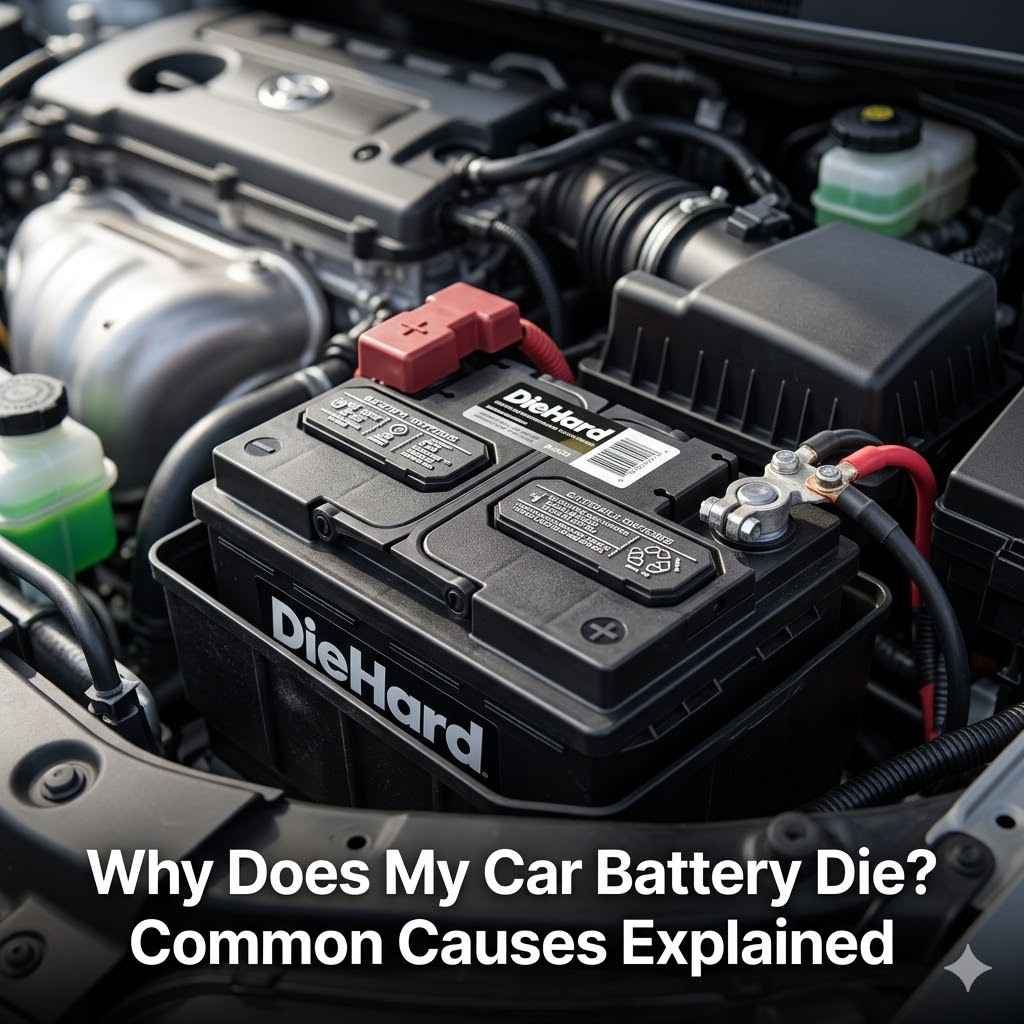
Source: Bing
A Practical Troubleshooting Decision Guide
Use the result of each test to narrow the diagnosis.
The battery is low, but the charging system works
Charge the battery fully and monitor it after the vehicle sits. If it repeatedly loses charge, test for parasitic draw. If the battery fails a load or conductance test, replace it.
The battery is good, but the vehicle has excessive key-off current
Inspect aftermarket accessories first because they are common sources of unwanted drain. Then isolate the affected fuse or module. Some vehicles require manufacturer-specific scan tools to identify a control unit that remains awake.
The battery and parasitic draw are normal, but the car still will not start
Check battery-terminal voltage during cranking, cable voltage drop, the starter motor, the engine ground, and the vehicle’s starting circuit. A no-crank problem is not always a battery problem.
The battery repeatedly goes dead after short trips
Measure charging performance and evaluate driving conditions. A battery maintainer approved for the battery type may help an infrequently driven vehicle, but it will not correct an electrical fault.
The battery dies only in winter
Have the battery load-tested, verify that it is fully charged, and inspect the terminals and charging system. Cold temperatures often expose a weak battery rather than create the original defect.
The vehicle dies after sitting for a month
A normal parked draw can eventually discharge even a healthy battery. For long-term storage, follow the vehicle manufacturer’s instructions and consider a properly rated battery maintainer. Some vehicles may require special procedures to preserve alarm, computer, and memory functions.
How Long Can a Car Sit Before the Battery Dies?
There is no universal number of days. The answer depends on the battery’s usable capacity, temperature, age, state of charge, vehicle standby current, and whether accessories remain connected.
A simplified estimate is:
[
\text{Approximate time in hours} = \frac{\text{usable battery capacity in amp-hours}}{\text{parked current in amps}}
]
This calculation is only a rough model. A vehicle should not normally use the battery’s entire rated capacity because the engine may fail to crank well before the battery is fully empty. Battery capacity also changes with temperature and age.
For example, a healthy battery with substantial usable capacity may tolerate a normal standby draw for many days. A weak battery with greatly reduced capacity may fail after only one or two nights under the same conditions.
The practical lesson is that “the car sat only two days” does not rule out a parasitic drain or weak battery.

Source: Bing
Common Mistakes That Make the Problem Worse
Replacing the battery without testing the vehicle
A new battery can hide the problem temporarily. If an alternator diode, accessory, or control module is draining the battery, the replacement may also discharge or fail prematurely.
Testing voltage immediately after driving
The battery can retain a temporary surface charge after charging. Letting it rest before testing produces a more useful open-circuit reading.
Assuming a jump-start fixed the problem
A jump-start only supplies enough energy to start the engine. It does not prove that the battery is healthy, that the alternator is working, or that the vehicle has no parasitic draw.
Leaving accessories connected
Phone chargers, dash cameras, portable refrigerators, inverters, and aftermarket electronics can continue drawing power after the ignition is off. Some vehicles keep accessory outlets powered longer than expected.
Using the wrong battery type
Vehicles designed for start-stop operation may require an AGM or enhanced flooded battery rather than a standard flooded lead-acid battery. Installing the wrong type can reduce service life and may require battery registration or charging-system programming.
Disconnecting the battery without checking vehicle requirements
Battery disconnection can erase radio settings, affect window and sunroof initialization, trigger security procedures, or require battery-management-system registration. Check the owner’s manual before disconnecting the battery.
When to Call a Professional
Seek professional diagnosis when:
- The battery is swollen, cracked, leaking, frozen, or hot
- The vehicle has a hybrid or high-voltage system
- A battery warning light is on
- The battery repeatedly dies after replacement
- The electrical draw is difficult to isolate
- The vehicle has extensive aftermarket wiring
- The car’s computers or alarm system behave unpredictably
- You are not comfortable working around batteries or live circuits
Hybrid and electric vehicles contain high-voltage components that are separate from the conventional 12-volt system but can still create serious hazards. Do not probe orange high-voltage cables or open high-voltage components unless you are trained and equipped to do so.
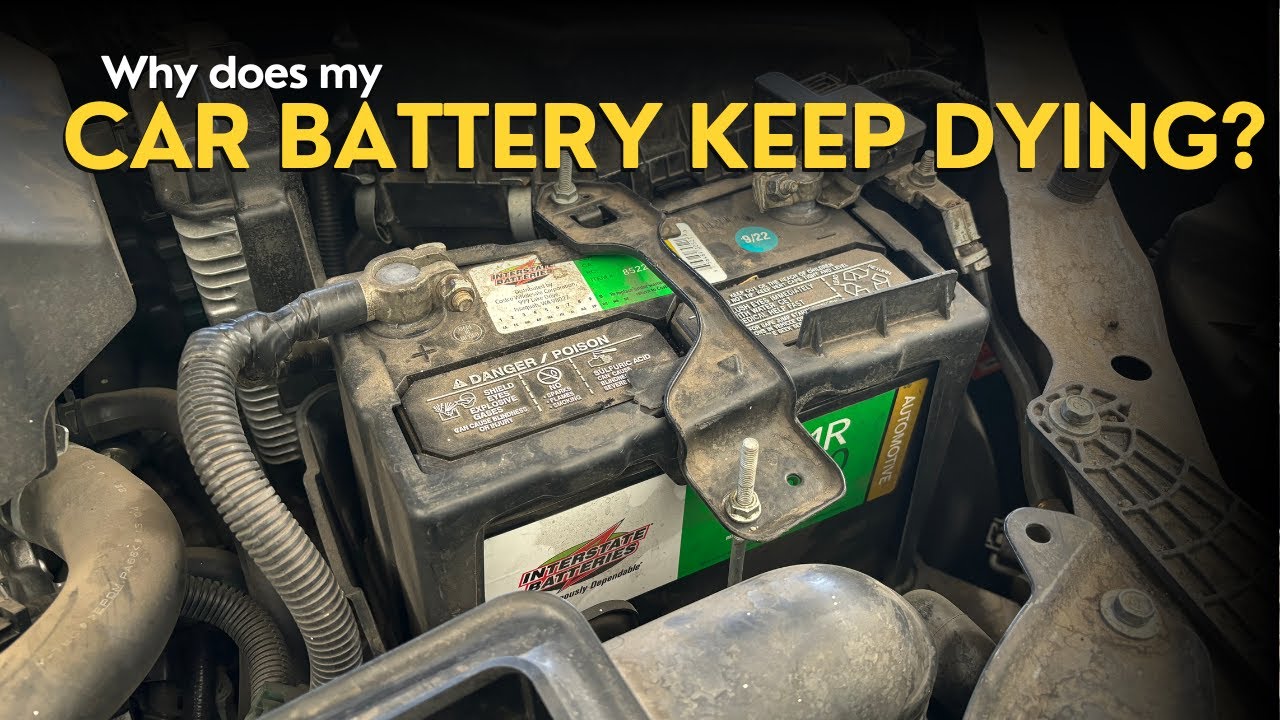
Source: Bing
Frequently Asked Questions
Why does my car battery die after sitting overnight?
The most likely causes are a weak battery, an excessive parasitic draw, or a charging system that did not fully replenish the battery. Start by checking resting voltage and battery age, then have the battery and charging system tested.
Can a bad alternator drain a battery while the car is off?
Yes. A failed alternator diode can allow current to flow backward from the battery through the alternator while the vehicle is parked. The alternator may also fail to recharge the battery while driving.
Does driving recharge a dead car battery?
Driving may recharge a partially discharged battery, but it is not a reliable way to restore a deeply discharged or damaged battery. Use a charger designed for the battery type, then test the battery and charging system.
Will disconnecting the negative terminal stop the battery from dying?
It can stop most vehicle-related electrical drain, but it also disables security systems, erases some settings, and may create computer or access issues. Follow the owner’s manual and do not use this as a substitute for diagnosing the fault.
Can cold weather cause a car battery to die?
Cold weather reduces available battery performance and increases the engine’s starting demand. It commonly exposes an aging or undercharged battery, although a severe parasitic drain or charging fault may still be the underlying cause.
How do I prevent a car battery from dying when the vehicle sits?
Keep the battery fully charged, repair abnormal electrical draws, limit plugged-in accessories, inspect the terminals, and use a compatible battery maintainer when the vehicle will sit for an extended period. The maintainer must match the battery type and be used according to its instructions.
Key Takeaways
- A car battery dies after sitting because of battery failure, parasitic draw, undercharging, short-trip use, temperature, or poor connections.
- A fully charged voltage reading does not prove that the battery can start the engine.
- Test the battery, charging system, and key-off electrical draw before replacing parts.
- Wait for the vehicle to enter sleep mode before measuring parasitic current.
- Treat swollen, leaking, frozen, or damaged batteries as safety hazards.
- Hybrid and electric vehicles require additional high-voltage safety precautions.
Conclusion
The most effective way to solve a car battery that dies after sitting is to separate the problem into three questions: Can the battery hold a charge? Is the alternator replacing the energy used during driving? Does the vehicle draw too much power while parked?
A battery test, charging-system test, and properly performed parasitic-draw test can answer those questions. If the battery is more than several years old, starts slowly, or has been discharged repeatedly, replacement may be appropriate—but only after confirming that the vehicle is not causing the failure.
For additional technical guidance, consult the vehicle owner’s manual and manufacturer service information. General battery-safety information is also available from the U.S. Department of Energy’s Alternative Fuels Data Center and OSHA’s battery-safety guidance, while vehicle-specific procedures should come from the manufacturer or a qualified automotive technician.