

Most cars have two axles, one in front and one in back.
Curious about how many axles are on a car? You’re in the right place. I’ve worked with daily drivers, off-road rigs, and even RVs, and I’ll walk you through what counts, why it matters, and how to check your own vehicle. By the end, you’ll know exactly how many axles you have, plus what that means for handling, maintenance, and cost.

What Is an Axle, Really?
An axle is the shaft or assembly that connects wheels and supports weight. It also delivers power to the wheels if it’s a drive axle. In modern cars, each axle usually supports a pair of wheels, and drive axles contain a differential and half shafts.
So, how many axles are on a car? In almost every standard car, there are two axles. One supports the front wheels, and one supports the rear wheels. Some vehicles have more due to extra wheels or higher load needs. This is common in trucks, RVs, and buses.
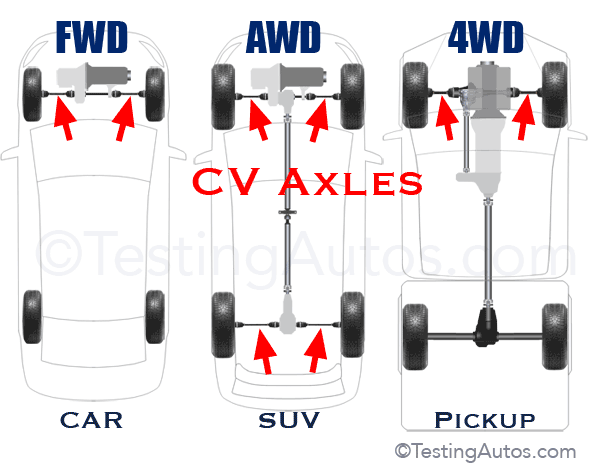
The Typical Number of Axles by Vehicle Type
The short answer to how many axles are on a car is still two. But the type of vehicle can change that. Here’s the general rule of thumb I use in the shop.
- Compact cars and sedans: Two axles with four wheels total
- SUVs and crossovers: Two axles, even with all-wheel drive
- Pickup trucks: Two axles, including dually setups with four rear tires
- Performance cars and EVs: Two axles, even with two or three motors
- RVs, buses, and some box trucks: Three or more axles for weight and stability
- Semi-trucks with trailers: Five or more axles combined, depending on configuration
If you’re wondering how many axles are on a car like a 6×6 conversion, the answer is three axles. More wheels usually mean more axles to spread weight and improve traction.

How To Check How Many Axles Your Car Has
When people ask me how many axles are on a car, I tell them to confirm with a quick look. It takes a minute.
- Count the wheel pairs. Two wheels across equals one axle. Four wheels usually mean two axles.
- Look under the car. You’ll see a front axle assembly for the front wheels and another at the rear.
- Check your manual or registration. Many state forms list axle count for tolls or weight class.
- Ask your service advisor. We can confirm based on the VIN and drivetrain layout.
In my garage, I once had a customer swear their AWD crossover had “four axles.” We checked the underbody together. It had two axles with a center transfer case. AWD changes power delivery, not the number of axles.
Why Axles Matter: Safety, Performance, and Wear
Understanding how many axles are on a car helps you predict how it drives and what might wear out.
- Power delivery. Drive axles send power to the wheels. FWD uses the front axle, RWD uses the rear, AWD can use both.
- Handling and ride quality. Independent axles and suspension design shape how the car feels in corners and over bumps.
- Load capacity. More axles spread weight. That’s why heavy vehicles add a third axle.
- Maintenance costs. More axles and more driven wheels mean more parts to check and service.
Knowing how many axles are on a car also helps when towing or loading. You avoid overloading an axle, which can cause bearing or tire failure.
Front, Rear, and Drive Axles Explained
If you ask a tech how many axles are on a car, we’ll also ask which type you mean.
- Front axle. Handles steering. On FWD vehicles, it’s often a transaxle with a built-in differential.
- Rear axle. On RWD vehicles, the rear axle assembly is driven by a driveshaft.
- All-wheel drive. Uses both axles. A transfer case or electric motor splits power front to back.
- Independent vs solid. Most cars use independent front and rear setups. Trucks may use a solid rear axle for strength.
EVs can have a motor at each axle. Even then, how many axles are on a car remains two for most EVs. The motors change how power flows, not the count of axles.
Signs of Axle or CV Trouble and What To Do
If you know how many axles are on a car, you can also spot issues faster. Here are symptoms I watch for during test drives.
- Clicking or popping while turning. Often a worn CV joint on a front drive axle.
- Shudder under acceleration. Could be a bent axle shaft or inner CV wear.
- Grease splatter inside the wheel. Usually a torn CV boot.
- Humming or growling at speed. A wheel bearing may be failing.
My advice is simple. Catch small axle problems early. Replace torn CV boots before they kill the joint. Rotate tires on schedule to reduce stress. And when in doubt, get a noise checked right away.
Costs: Repairs, Upgrades, and When To Replace
People often pair cost questions with how many axles are on a car. More axles can mean more parts to maintain.
- CV axle replacement. Often one to three hours of labor, plus parts. Many cars fall in the mid-range cost for one side.
- Wheel bearings. Press-in bearings take longer. Hub units are faster and can cost less for labor.
- Performance upgrades. Stronger axles for track or off-road use can be pricey but worth it if you push the car hard.
If you track budgets, plan for axle-related maintenance every 60,000 to 100,000 miles, or sooner with rough roads, big wheels, or heavy loads.
Legal, Insurance, and Tolls: Why Axle Count Shows Up on Forms
It might feel odd to see axle count on paperwork, but it serves a purpose. When you know how many axles are on a car, you avoid surprises.
- Toll roads and weigh stations. Fees and limits can depend on the number of axles.
- Registration and inspection. Some states ask for axle count for classification.
- Insurance. It rarely changes your rate for cars, but it matters for RVs and commercial vehicles.
If you tow a trailer, remember the trailer adds axles for tolls and load ratings. Always check local rules before long trips.
Real-World Examples From the Shop
Experience helps answer how many axles are on a car in ways that specs alone miss. Here are a few quick stories.
- Family SUV with AWD. Customer thought AWD meant four axles. We showed them the two axles plus a center unit that splits power.
- Dually pickup. Four rear tires looked like an extra axle. Still two axles, just more tires on the rear.
- 6×6 off-road build. This one did have three axles. It needed extra support for payload and traction on rock trails.
Simple rule I share with new drivers: count wheel sets, not tires. That’s the easiest way to know how many axles are on a car.
Frequently Asked Questions of how many axles are on a car
Do all cars have two axles?
Most cars have two axles, one front and one rear. That covers sedans, SUVs, pickups, and most EVs.
Does all-wheel drive change the number of axles?
No. AWD changes how power is sent to the wheels, not how many axles you have. Most AWD cars still have two axles.
How many axles does a dually truck have?
A dually truck still has two axles. It just has two wheels on each side of the rear axle for extra load capacity.
How many axles does a 6×6 vehicle have?
A 6×6 vehicle has three axles. Each axle supports a pair of wheels, hence six wheels total.
Can a three-wheel car still have two axles?
Yes. One axle supports the single wheel, and the other supports the pair. You still end up with two axles.
How can I quickly tell how many axles are on a car?
Count the wheel pairs: front pair is one axle, rear pair is another. Most standard cars have two pairs, so two axles.
Do electric vehicles have more axles because of extra motors?
No. Extra motors do not add axles. Most EVs still have two axles, even with dual or tri-motor setups.
Conclusion
Most drivers will never need to think beyond this: your car has two axles. But knowing how many axles are on a car helps you spot problems, plan maintenance, and avoid surprises with towing or tolls. Take a minute today to count your wheel pairs, check your manual, and note your drivetrain. If you have questions, drop a comment, subscribe for more simple car tips, or reach out for a quick axle check at your next service visit.
2 thoughts on “How Many Axles Are On A Car: Quick Answer & Tips”